




Special Collections:
The Economy

Discussions addressed critical global economic issues: macroeconomic imbalances, currency instability, global governance (G20), and the international financial system.
Key participants included Montek Singh Ahluwalia, Robert E. Diamond Jr., Christine Lagarde, George Osborne, Wolfgang Schäuble, Yu Yongding, and Robert B. Zoellick. The session was chaired by Martin Wolf, Associate Editor and Chief Economics Commentator for the Financial Times.

There's a significant opportunity to rethink and redesign how we make things. The "Re-Thinking Progress" initiative explores how a change in perspective can transform our economy, enabling us to design products "made to be made again" and power systems with renewable energy. This approach aims to build a creative, innovative, and restorative economy.
Discover more about the circular economy and its economic and business rationale through the Ellen MacArthur Foundation. Explore their "Towards the Circular Economy" reports and follow them on Twitter for further insights.

Nobel laureate Michael Spence spoke to Googlers on May 24, 2011, about his book, *The Next Convergence: The Future of Economic Growth in a Multispeed World*.
The book is expected to spark debate on post-crisis economic recovery, addressing the balance between national and international interests, and short-term fixes versus long-term sustainability. Order it from Amazon.
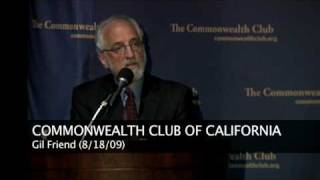
Many believe profitable businesses cannot also be environmentally and socially responsible. However, Gil Friend asserts that green business practices benefit both companies and the world, extending beyond mere shareholder value and profit.
Friend, Founder/CEO of Natural Logic, Inc., is the author of The Truth About Green Business.

The standard Triple Bottom Line (TBL) of Planet, People, and Profit often overlooks equity, viewing people as consumers rather than citizens. Julia Anastasio, Director of Sustainability for the American Public Works Association (APWA), emphasizes social sustainability, community well-being, and the vital role of public works.
Anastasio shared these insights during an interview with Ruth Ann Barrett of Earthsayers.tv at the APWA Sustainability in Public Works Conference, held June 27-29 in Portland, Oregon.
Richard Heinberg, a senior fellow at the Post Carbon Institute and author of "The Party's Over," "Peak Everything," and "Blackout," discusses the phenomenon of peak oil and its global implications.
He explains that the era of easily accessible resources is over. The new reality of expensive oil will likely become the norm, potentially leading to economic recession.
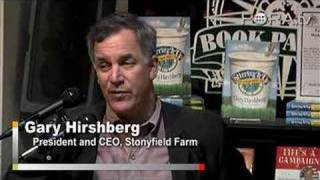
Stonyfield Farm CEO Gary Hirshberg argues that environmentally sustainable business practices offer significant long-term financial advantages.
Watch the complete video discussion: How to Make Money and Save the World
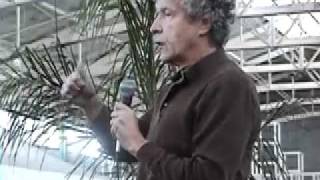
Economist John Perkins, co-founder of Dream Change and The Pachamama Alliance, discusses the crucial balance between corporate profit and responsibility. While acknowledging that companies can make a return on investment, Perkins emphasizes a vital message regarding their impact.
He offers a list of ten things you can do to save the Earth. Follow his insights on Twitter.
This discussion was recorded by Ruth Ann Barrett of EarthSayers.tv at the 2010 Global Summit in San Francisco.

This documentary trailer features a global chorus of voices, including Vandana Shiva, Bill McKibben, David Korten, Juliet Schor, and Samdhong Rinpoche, Prime Minister of Tibet's government in exile. These experts from six continents address urgent global challenges.
They argue that climate change and peak oil necessitate a critical shift: we must localize economies and bring them home.

Lester R. Brown was interviewed in Stockholm on May 7th-8th (Part 1/12). He discussed ecological security, focusing on food as a potential weak link amidst significant future changes.
The interview explores humanity's capacity to manage these transformations. Brown is affiliated with the Earth Policy Institute.

Marketing expert Anthony Kleanthous recently outlined effective strategies for organizations to influence public green behavior.
In a related initiative, the World Wildlife Fund (WWF) has established a new group. This group will focus on consumption, specifically addressing the demand side of environmental impact.

Nobel laureate Elinor Ostrom, an Arthur F. Bentley Professor of Political Science at Indiana University, voiced her concern about the promotion of singular solutions for complex issues.
She emphasized that news and textbooks often present a "one way" approach, when in reality, no single recipe can adequately address such multifaceted problems.

Part Two of the second panel of the Business in the Community Ireland Summit on Corporate Responsibility: Transforming to a Sustainable Business was held on Thursday, November 18, 2010.
The panel featured Roger Steare, the Corporate Philosopher and a professor at Cass Business School. Other panelists included James Quincey (The Coca Cola Company), Sir Stuart Rose (Chairman, Marks & Spencer), Richard Jackson (Olympic Delivery Authority), and Gerard O'Neill (Amarach).

Economics professor and author Robert Frank delivered a lecture as part of the Authors@Google series on July 23, 2007, at Google headquarters in Mountain View, CA.
During his talk, Frank discussed basic economic principles, notably the concept of pursuing actions where benefits exceed costs. He is the author of "The Economic Naturalist: In Search of Explanations for Everyday Enigmas."

"Toward a Truly Free Market: A Distributist Perspective on the Role of Government, Taxes, Health Care, Deficits, and More" addresses why three decades of free-market efforts against Keynesian policies have led to larger government, greater debt, and centralized economic power. It asks how a truly free market can be achieved amidst capitalism's current crisis.
John C. Médaille, author of *The Vocation of Business: Social Justice in the Marketplace*, is an economics instructor at the University of Dallas. He writes and lectures on economics, with over thirty years in corporate management, small business, and five terms as an Irving, Texas city councilman.
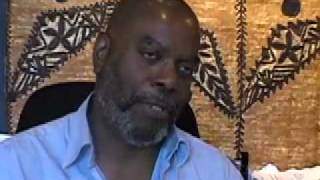
Dr. Sharif Abdullah, Founder and President of the Commonway Institute, explores criminality and morality across five economic systems. He highlights that legality does not always equate to morality.
His book, Creating a World That Works for All, delves deeper into these concepts.
Discover more related films, lectures, and interviews in EarthSayers.tv's Transforming Our Economy special collection.

This RSA Animate features philosopher Slavoj Zizek exploring the surprising ethical implications of charitable giving.
The content originates from the RSA, a long-standing charity dedicated to fostering social progress and disseminating world-changing ideas through its research, Animates, and free public events program. For more information, connect with the RSA via social media:
Follow on Twitter, like on Facebook, listen to podcasts, and see behind-the-scenes on Instagram. Produced and edited by Abi Stephenson; animation by Cognitive Media.

John Fullerton of the Capital Institute spoke with Ruth Ann Barrett of EarthSayers.tv about aligning capital with sustainability principles and the emergence of impact investing. He detailed how he integrates his personal values for a sustainable future into his own investment activities.
Fullerton also referenced the recent SoCap10 conference in San Francisco. He described it as the largest interdisciplinary gathering of individuals and institutions focused on the intersection of money and meaning.
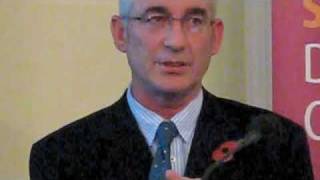
The suitability of our current economic model for a low-carbon world is under scrutiny. Tim Jackson, author of "Prosperity without Growth," argues that economic growth relentlessly drives us towards climate catastrophe, rather than offering a solution. He asserts that building a new economic model fit for a low-carbon future is the most urgent task of our time.
Professor Jackson contends that the prevailing system is failing, undermining wellbeing in rich nations and neglecting the poorest. He warns that it has already led to economic instability and, if unchecked, threatens a climate catastrophe. His book, an update to a highly acclaimed report, has significantly fueled the burgeoning debate on economic growth and its global consequences.

Is our economy fit for a low-carbon world? Tim Jackson, author of *Prosperity without Growth*, argues that the current economic model is driving us towards climate catastrophe, not away from it. He asserts that building a new, sustainable economic model is the most urgent task of our time.
Jackson, a leading sustainability adviser, contends that the prevailing system fails to deliver widespread prosperity, undermining wellbeing in rich nations and neglecting the poorest. Having already led to economic instability, it now threatens a climate crisis. His book, an update to a groundbreaking report for the Sustainable Development Commission, has significantly contributed to the burgeoning debate on economic growth's consequences for people and planet.
Environmental Scientist and Advocate
What EarthSayers stands for
Discover Diverse Voices on EarthSayers
Unlike algorithm-driven platforms that push you into a content bubble, we ensure you hear a variety of perspectives from scientists, activists, Indigenous leaders, business innovators, and everyday citizens working toward sustainability.
EarthSayers CINEMA
Watch, learn and lead—sustainability starts with you.
The Many Passions of Matteo Lane
Matteo Lane is a multifaceted artist—stand-up comedian, painter, singer, and Broadway performer. In this interview, he shares how these skills intertwine in his creative process, likening art to a tree that branches out in various directions.
We explore his role as Billy Flynn in Broadway’s Chicago, his journey from bar shows to international comedy tours, and the evolution of gay representation in comedy. Lane also discusses his artistic roots at the School of the Art Institute of Chicago, his admiration for Maria Callas, and his philosophy of focusing on the journey of creation rather than the end product.
Official website: pbs.org/americanmasters


