




Special Collections:
Forests and Oceans

Interceptor 011 in Kingston, Jamaica, captures trash in rivers before it reaches the ocean, improving the lives of coastal communities.
While not a solution to upstream challenges, the data collected helps enhance our 30 Cities Program, which aims to reduce global plastic emissions by one-third by 2030. We also collaborate with governments and policymakers to promote upstream change.

🦈 Healthy oceans depend on sharks. These vital predators maintain balance in ocean ecosystems by regulating prey populations and preying on old and sick fish, which promotes overall fish health.
Protecting these iconic ocean animals is crucial now more than ever.

Ocean acidification is weakening sharks' teeth, posing significant risks to marine ecosystems.
This change highlights the broader impact of climate change on ocean life.

Check out the latest catch from Interceptor 006 in the Rio Las Vacas, Guatemala 🇬🇹.

Rizky Oktaviana endured 18 months of unpaid labor as a fisher on a trawling vessel, witnessing illegal fishing practices and harsh conditions. Now, he advocates for the rights of migrant fishers, highlighting that at least 128,000 fishers are currently trapped in forced labor at sea. Illegal, unreported, and unregulated (IUU) fishing not only exploits workers but also threatens marine ecosystems and global food security, costing between $26 to $50 billion annually.
To combat these abuses, coordinated action is essential, including stronger protections from policymakers and transparency in seafood supply chains. Learn more about fishers' journeys from exploitation to advocacy and how we can work together for a better future for fishers and our oceans: Fishers Speak Out.

Giant Pacific octopuses are known for their intelligence, capable of remembering landmarks, navigating their environment, and using tools.
Discover more about these fascinating cephalopods in our Marine Life Encyclopedia.

Microplastics are pervasive, contaminating our environment, bodies, and food globally. Awareness of this issue has surged in recent years, prompting the need for action.
Discover more about microplastics and Oceana's initiatives to combat the plastic crisis at Oceana. Stay updated by subscribing to Oceana's channel at this link, or become a Wavemaker to support ocean conservation at this link. Follow Oceana on Facebook, Instagram, X, and TikTok.

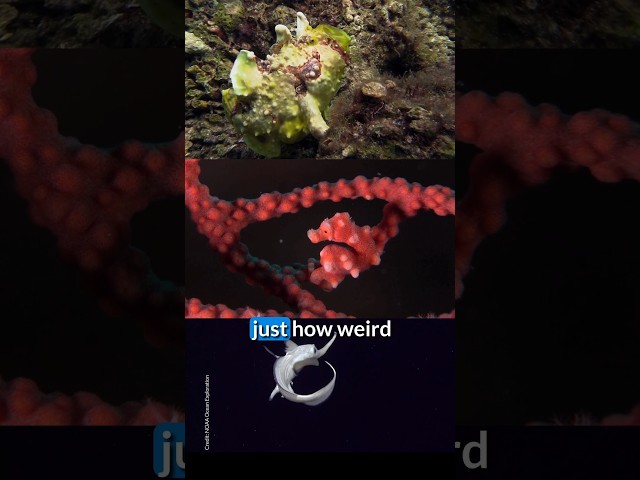
Ocean evolution has produced fish in a variety of shapes and sizes. Some fish use their pectoral fins to "walk," while others, like ghost sharks, thrive in the dark depths of the ocean.
These unique adaptations make these ocean animals well suited for life beneath the waves.

In 2022, Oceana researchers spent eight days exploring 23 sites around Kodiak Island to study deep-sea corals and seafloor habitats. The expedition revealed a vibrant ocean ecosystem from the surface to the seafloor.
The goal was to enhance understanding of the Gulf of Alaska's seafloor to aid Oceana's campaign against destructive bottom trawling.
🌊 Get Involved 🌊
Subscribe to Oceana: https://oceana.ly/subscribe
Become a Wavemaker: https://oceana.ly/4rGhn8Z
Follow us on Facebook, Instagram, X, and TikTok.
In August, The Ocean Cleanup expanded operations to Colombia, signing a Memorandum of Understanding with Santa Marta to deploy Interceptors in the Río Manzanares and Río Gaira. This initiative is part of the 30 Cities Program, aiming to prevent one-third of river plastic from entering the ocean by 2030.
In Panama City, Interceptors 024 and 025 effectively managed trash influx during heavy rains, while in Jamaica, Interceptors 011, 013, and 015 stopped tons of waste from reaching the Caribbean Sea. Additionally, our team tested the Smart Steering Strategy in the Great Pacific Garbage Patch and plans to share findings soon. An upgrade for Interceptor 004 in the Dominican Republic will include a new 400-meter barrier to enhance plastic capture.


The deep sea urgently needs protection as corporations rush to mine minerals in fragile habitats, risking the destruction of ecosystems we barely understand. In this video, Oceana Senior Advisor Alexandra Cousteau highlights the detrimental effects of deep-sea mining on marine life.
We must prevent the exploitation of this unique ecosystem. Join us in urging lawmakers to halt the fast-tracking of deep-sea mining: https://oceana.ly/4cm1NdO. Stay updated by subscribing to Oceana: https://oceana.ly/subscribe and become a Wavemaker: https://oceana.ly/4rGhn8Z. Follow Oceana on Facebook, Instagram, X, and TikTok.

📍 Panama
Check out one of Interceptor 024's latest catches! Stay tuned until the end to see a person for scale.

August brought significant positive developments for our oceans. Federal lawmakers took a stand against the Trump administration to protect endangered species.
Additionally, a brutal annual seabird hunt was canceled for the first time in over 400 years, marking a notable victory for marine conservation.

Cardinalfish fathers exhibit a unique parenting behavior by carrying their eggs in their mouths for protection.
Learn more about these fascinating creatures and their role in marine life.
Plastic pollution threatens the pristine natural beauty and biodiversity of U.S. national parks, from Glacier Bay's icebergs to Dry Tortugas' coral reefs.
This National Parks Week, join the effort to protect these vital habitats from plastic waste. Learn more at Oceana.

The Great Pacific Garbage Patch (GPGP) is the largest offshore plastic accumulation zone, located between Hawaii and California. Each year, an estimated 1.15 to 2.41 million tonnes of plastic enter the ocean from rivers, with over half of it being buoyant and unable to sink.
The GPGP spans approximately 1.6 million square kilometers, twice the size of Texas. Its location and shape fluctuate due to seasonal and interannual changes in winds and currents, with the patch generally orbiting around 32°N and 145°W. Researchers have noted significant variations in its position, influenced by ocean currents.

In the past year, scientists have uncovered some extraordinary species, including hairy fish and carnivorous "death-ball" sponges.
These discoveries highlight the incredible diversity of ocean wildlife and the ongoing importance of STEM research in understanding our planet's ecosystems.

We are expanding our operations to Santa Marta, Colombia, having signed a Memorandum of Understanding with the city to implement Interceptor solutions. These will capture plastic waste in the Río Manzanares and Río Gaira before it reaches the Caribbean Sea.
This partnership with the City of Santa Marta and Corapmag (Corporación Autónoma Regional del Magdalena) will also focus on downstream cleanups and responsible waste management, preventing collected plastic from re-entering the environment. Through collaboration with local stakeholders, we aim to protect marine ecosystems and support Santa Marta’s environmental stewardship as part of our 30 Cities Program to reduce global river plastic by 2030.
Environmental Scientist and Advocate
What EarthSayers stands for
Discover Diverse Voices on EarthSayers
Unlike algorithm-driven platforms that push you into a content bubble, we ensure you hear a variety of perspectives from scientists, activists, Indigenous leaders, business innovators, and everyday citizens working toward sustainability.
EarthSayers CINEMA
Watch, learn and lead—sustainability starts with you.
The Many Passions of Matteo Lane
Matteo Lane is a multifaceted artist—stand-up comedian, painter, singer, and Broadway performer. In this interview, he shares how these skills intertwine in his creative process, likening art to a tree that branches out in various directions.
We explore his role as Billy Flynn in Broadway’s Chicago, his journey from bar shows to international comedy tours, and the evolution of gay representation in comedy. Lane also discusses his artistic roots at the School of the Art Institute of Chicago, his admiration for Maria Callas, and his philosophy of focusing on the journey of creation rather than the end product.
Official website: pbs.org/americanmasters


