




Special Collections:
Wisdom Keepers

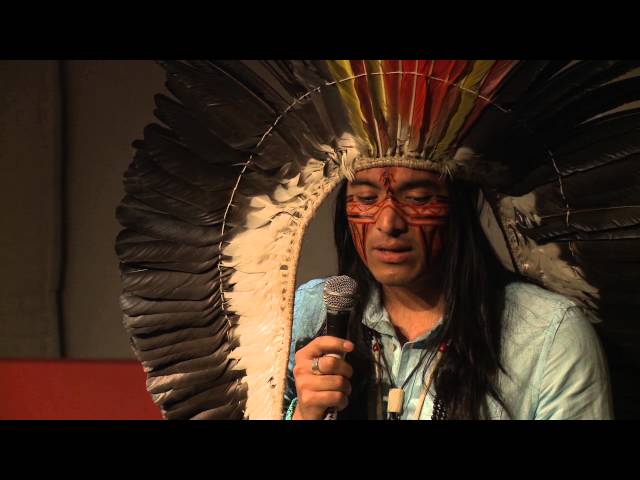
Nixiwaka Yawanawa, from the Yawanawa tribe, highlights our intrinsic connection with nature. He presented these insights at TEDxHackney.
Nixiwaka also delivered a second TED Talk, available here, further exploring his perspectives.

For millennia, Indigenous communities have been environmental guardians, using traditional knowledge to live in balance and protect flora and fauna. They safeguard 80% of the world's biodiversity, and protecting these lands and waters is crucial for climate mitigation, as these biodiverse areas are major carbon sinks. Indigenous peoples are the ancestral owners of nearly half the intact forest in the Amazon Basin.
Nemonte Nenquimo, a Waorani leader and co-founder of Ceibo Alliance and Amazon Frontlines, stresses that respecting Indigenous peoples' rights to their territories is vital for protecting the Amazon rainforest, our climate, and global life. Recognized by Time's 100 most influential people and a Goldman Environmental Prize winner, Nenquimo advocates against oil drilling on ancestral lands.
Learn more at Amazon Frontlines and explore more Bioneers videos.
The Turtle Lodge and Manitoba First Nations Education Resource Centre (MFNERC) present Wahbanang: The Resurgence of our People – Clearing the Path for Our Survival. It commemorates the 50th Anniversary of Wahbung: Our Tomorrows.
Authored by Anishinaabe, Ininiwak (Cree), and Dakota Knowledge Keepers, Elders, and Chiefs, Wahbanang shares ancestral wisdom. It offers an urgent warning and a blueprint for all peoples to uphold the Great Binding Laws of the Creator and Mother Earth. Includes a video presentation.
Wahbanang, meaning 'Going Back to the beginning,' builds on the 1971 Wahbung, which asserted First Nations' inherent rights. It originated from a 2018 Assembly of Manitoba Chiefs (AMC) initiative at the Turtle Lodge. It is available for purchase here.

Grandmother Katherine Whitecloud teaches that addiction arises from unresolved trauma and disconnection from ancestral ways. Healing involves understanding our individual gifts and responsibilities, learned through ceremony with Elder and family support.
The Turtle Lodge International Centre, in partnership with Sagkeeng Mino Pimatiziwin, provides guidance for addiction recovery. Join us as we share Elders' messages on healing for a balanced life.
View our series playlist: YouTube Playlist. Learn more about Turtle Lodge's mission to reconnect with Earth and ancestral knowledge at www.turtlelodge.org, and follow us on social media.

In June 2021, economist Tim Jackson and Garrison Institute co-founder Jonathan F. P. Rose discussed envisioning a viable future. Their conversation explored the worldview and systemic changes necessary to address the root causes of climate change, social inequity, and financial instability.
They identified capitalism itself as the underlying issue. Jackson further explores this post-capitalist future in his forthcoming book, *Post Growth: Life After Capitalism*.

Anton Treuer explains the origin, function, and historical evolution of the Ojibwe clan system.
This presentation, delivered in English with some Ojibwe vocabulary, took place on March 28, 2021.

Debra Haaland was confirmed as U.S. Interior Secretary on March 15, 2021, making her the first Native American Cabinet secretary. She will oversee energy and climate policy on millions of acres of public land, alongside the Bureau of Indian Affairs.
PBS Newhour explored the significance of her appointment for Native Americans, featuring a discussion with Timothy Nuvangyaoma, chairman of the Hopi Tribe in Arizona.

Howard Zinn (1922-2010) delivered his talk, "The Myth of American Exceptionalism," at MIT on March 14, 2005. This was the inaugural lecture in the "Myths About America" series, organized by MIT's Special Program for Urban and Regional Studies (SPURS).
Zinn, a renowned historian, playwright, and self-described democratic socialist, is best known for "A People's History of the United States" (1980). He previously chaired the history and social sciences department at Spelman College and served as a political science professor at Boston University.
For more information, please visit the MIT Infinite History site.

Howard Zinn (1922-2010) was an American historian, playwright, and socialist thinker.
He chaired the history and social sciences department at Spelman College and taught political science at Boston University. Zinn authored over 20 books, including his best-selling and influential *A People's History of the United States*.

This six-hour live stream captures presentations from World Peace and Prayer Day (2020).
It features an introduction by Chief Arvol Looking Horse, alongside a presentation by Guy Jones, Hunkpapa Lakota, on Newark EarthWorks, Ohio, U.S.A.

Dr. Rob Silberstein, born with a severe joint and muscular disability, is a lifelong learner who achieved multiple degrees, including medicine and law. He made history as Australia's first registered medical doctor with a substantial physical disability, subsequently becoming a powerhouse in commercial law.
Combining his unique qualifications, Dr. Silberstein dedicates his life to advocating for equal access to education and vocational opportunities for people with disabilities. He runs Silberstein & Associates with his wife, Jessica, and continues this vital work through The Northcott Society and Northcott Innovation. This talk was given at a TEDx event. Learn more at https://www.ted.com/tedx.

The discussion underscored the critical importance of human connection. Our minds naturally foster honor, respect, and good treatment towards those we feel connected with, a principle evident in our daily group interactions.
However, we have allowed divisiveness and fear to turn us against each other. The imperative now is to expand this sense of connection beyond our immediate circles, embracing a larger group: one humanity.

The inaugural States of Change Learning Festival opens with award-winning author and thinker Tyson Yunkaporta, joined by Angie Tangaere.
Yunkaporta, an Apalech Clan academic and senior lecturer in Indigenous Knowledges, will explore how Indigenous thinking embraces the world's complexity. Unlike our tendency to simplify, Indigenous perspectives communicate deep knowledge through art and stories, offering crucial insights into history, education, power, and sustainable living. Can we truly achieve sustainability without this vital knowledge?

Environmentalist and writer Jonathon Porritt discussed the evolution of green politics with John Vidal in a 2012 interview for The Guardian.
His latest book, *Hope in Hell*, published in 2020, is available from Amazon.

On World Environment Day 2020, Jojo Mehta, co-founder of the Stop Ecocide campaign, engaged in a frank yet optimistic conversation with veteran environmentalist and author Jonathon Porritt. Porritt, whose new book *Hope in Hell* was released that month, brought decades of experience addressing environmental and climate crises at NGO and government levels.
Mehta, building on the legacy of visionary lawyer Polly Higgins, discussed how activism and leadership can drive change. Their dialogue explored the crucial rules we must alter—from criminal law to state policy and everyday actions—to transform our world. Learn more about Stop Ecocide.

Matthieu Ricard, a Buddhist monk and public thinker, advocates cultivating altruistic love and compassion to address key challenges: short-term economic stability, mid-term life satisfaction, and long-term environmental sustainability. His radical yet simple message has influenced economists like Amartya Sen and Joseph Stiglitz, and he has shared it at Davos and the United Nations.
Ricard asserts this ancient wisdom benefits both society and individuals. Despite its simplicity, the text questions why implementing this solution to our 21st-century predicaments proves so challenging.

In a 1994 interview, host Marcia Alvar speaks with Wilma Mankiller, Principle Chief of the Cherokee Nation (1983-1995). Mankiller discusses experiences from her book, "Mankiller: A Chief and Her People."
She details her early political activism, her return to Oklahoma, and subsequent involvement with the Cherokee tribe. The conversation covers her election as tribal chief, her time in office, and reflections on her tenure as she prepared to step down.

The Prophecy of the White Buffalo has been preserved by the Magaska Ptesan Wicoti, Hinhan Wicasa Oyate for over 160 years.
Chief Phil Lane of the Four Worlds International Institute describes this ancient prophecy.

Wallace Black Elk emphasized that humans are inherently born with love, kindness, generosity, and a giving spirit. Connie Baxter Marlow, author of "Walking in Trust: Radical Childrearing," highlighted trust as fundamental to harmonious living and a new way of being. She asserted that each child inherently knows their path, advocating trust in a loving universe.
This philosophy aligns with a Native American approach to discovery, urging individuals to listen to circumstances and observe signs. Themes of healing separation and courage were also central to their discussion. These insights were shared by Wallace Black Elk, Connie Baxter Marlow, and Sally Ranney in Aspen, Colorado, on July 13, 1998, as excerpts from "REALITY CHECK!"

Wallace Black Elk teaches that doubt separates us from the Creator, shaping our reality. He advocates understanding nature's elements and for humanity to unite, restoring universal telepathic language.
His insights, titled "Trust Brings Freedom 2 of 2," are available here.
Sally Ranney further explores "The Trust Frequency," a concept developed over 15 years in close association with Black Elk and other visionary elders. For more information, visit TheTrustFrequency.net.
Environmental Scientist and Advocate
What EarthSayers stands for
Discover Diverse Voices on EarthSayers
Unlike algorithm-driven platforms that push you into a content bubble, we ensure you hear a variety of perspectives from scientists, activists, Indigenous leaders, business innovators, and everyday citizens working toward sustainability.
EarthSayers CINEMA
Watch, learn and lead—sustainability starts with you.
The Many Passions of Matteo Lane
Matteo Lane is a multifaceted artist—stand-up comedian, painter, singer, and Broadway performer. In this interview, he shares how these skills intertwine in his creative process, likening art to a tree that branches out in various directions.
We explore his role as Billy Flynn in Broadway’s Chicago, his journey from bar shows to international comedy tours, and the evolution of gay representation in comedy. Lane also discusses his artistic roots at the School of the Art Institute of Chicago, his admiration for Maria Callas, and his philosophy of focusing on the journey of creation rather than the end product.
Official website: pbs.org/americanmasters


