




Special Collections:
The Circular Economy


Our food systems significantly impact climate change. Historically, agriculture has relied on extractive practices, leading to less nutritious food. Can we instead grow food regeneratively, providing more valuable nutrients and fostering restorative practices?
This question was explored in a live episode featuring Sheena Shah (Harvesting for Good East Africa) on permaculture, Nicole Gobeth (Connect the Dots) discussing policy and São Paulo's circular food economy, and Jeanette Coombs-Lanot (Danone) on large businesses' role in regenerative food production. The discussion highlighted pathways to a more sustainable food future.
Watch the full episode and explore more about food and the circular economy.

Powered by Restream
Our food system significantly impacts climate change. Historically, extractive farming has met global demand but often resulted in less nutritious food. This raises a crucial question: can regenerative and restorative practices provide more valuable nutrients while sequestering carbon and restoring soil health?
This episode explores regenerative food sourcing. We'll hear from Sheena Shah (Harvesting for Good East Africa) on practices in East Africa, Nicole Gobeth (Connect the Dots) on policy and São Paulo's circular food economy, and Danone on how large businesses are ensuring regenerative food production.

This session focuses on solutions for plastic packaging. On November 19th, the Ellen MacArthur Foundation released "Upstream Innovation - a guide to packaging solutions." This practical guide offers tips, decision frameworks, and 110 case studies to help organizations achieve their circular economy targets for packaging.
A suite of additional assets, including workshop templates, slide decks, videos, and a case study database, accompanies the guide. Join this open session to learn more about these solutions, understand how to get started, and receive an exclusive tour of the developed resources.

By 2025, an estimated 160 million people — 5% of the workforce — will design everything from our clothes to transport systems. As the circular economy gains momentum, designers are rethinking product creation and use. Yet, innovation and pioneering efforts are crucial to scale this transition.
These highlights are from a live episode streamed on March 2nd, featuring Lay Koon Tan (Nature Squared) and Katie Treggiden (Wasted). The discussion explored circular design's opportunities and challenges, emphasizing design's pivotal role in the circular economy transition.
Watch the full episode, find out more about Circular Design, or explore more episodes of The Circular Economy Show. Learn more about our work here.

As the circular economy gains momentum, designers and innovators are rethinking how products are made and used. However, significant innovation is still needed to scale this transition, with many solutions yet to be established.
This episode will explore the opportunities and challenges in circular design, examining what the journey towards its full implementation looks like. Powered by Restream.
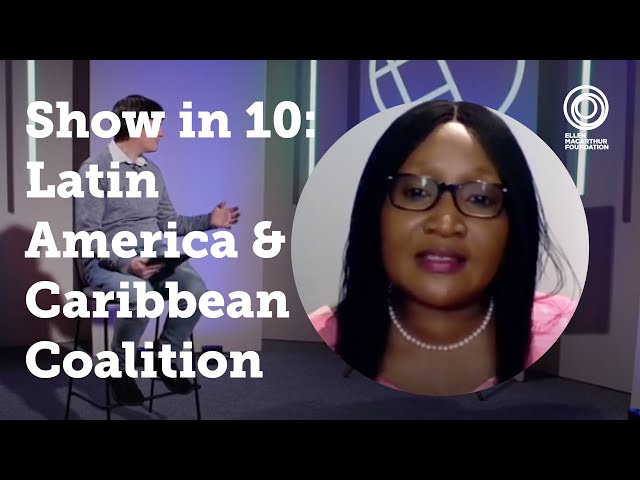
The circular economy is gaining traction in Latin America and the Caribbean (LAC), prompting eight institutions to launch the LAC Circular Economy Coalition. This initiative supports countries and fosters multi-stakeholder collaboration.
A recent panel discussion, streamed live on February 16th, featured coalition representatives including Adriana Zacarias Farah (UNEP), Rose Mwebaza (CTCN), Luisa Santiago (Ellen MacArthur Foundation), and Rolando Castro (MINAE Costa Rica).
For more information, watch the full episode, explore the LAC Coalition, or discover other episodes of The Circular Economy Show and our work.

Our five Universal circular economy policy goals offer governments a path to resilient post-COVID recovery and solutions for global challenges like climate change, biodiversity loss, and pollution. These goals were central to a live panel discussion on February 2nd, moderated by Eline Schaart (POLITICO Europe) and featuring Steven Schonberger (World Bank), Roberta Dessi (Inter IKEA Group), and Miranda Schnitger (Ellen MacArthur Foundation). The panel emphasized the importance of aligning sub-national, national, and international policies to scale the circular transition.
Watch the full episode and learn more about the Five Universal circular economy policy goals. Explore more Circular Economy Show episodes and our broader work.

The circular economy is gaining significant momentum across Latin America and the Caribbean (LAC), with governments actively developing related policies. In response, eight institutions have launched the LAC Circular Economy Coalition to support countries and foster multi-stakeholder collaboration.
This episode features a discussion with strategic partners: Adriana Zacarias Farah (UNEP), Rose Mwebaza (CTCN), Luisa Santiago (Ellen MacArthur Foundation), and Rolando Castro (Vice Minister, MINAE, Costa Rica).
Powered by Restream.

Powered by Restream: https://restream.io/
Our five new Universal circular economy policy goals empower governments to achieve a resilient COVID-19 recovery. These goals offer solutions to critical global challenges like climate change, biodiversity loss, and pollution.
This discussion panel, moderated by Eline Schaart (POLITICO Europe), features Steven Schonberger (World Bank), Roberta Dessi (Inter IKEA Group), and Miranda Schnitger (Ellen MacArthur Foundation). They will explore the importance of aligning sub-national, national, and international policies to scale the circular economy transition.

São Paulo, a diverse megacity, exemplifies a circular food economy. The City Hall supports farmers in adopting regenerative agriculture and accessing markets. This initiative ensures healthy, fresh food for local markets and restaurants.
Family farmers in peri-urban areas gain new opportunities, improving their quality of life. Additionally, inedible by-products and bio-waste are composted locally, returning vital nutrients to the soil. This comprehensive approach benefits everyone involved.

This session delves into financing and measuring the circular economy. Discover how it drives new growth, achieves climate and ESG goals, and how its financing market has rapidly expanded across asset classes. We will also explore methods for measuring circularity performance to inform decision-making for both business leaders and financiers.
The Ellen MacArthur Foundation, a UK charity, accelerates the transition to a circular economy through business initiatives, learning, insights & analysis, and communications. Learn more about our work: www.ellenmacarthurfoundation.org.

Current challenges demand new economic thinking that balances people's wellbeing, planetary boundaries, and a thriving economy. Kate Raworth, author of *Doughnut Economics*, will discuss her framework's role in shaping circular economy policies and business practices at the city level.
Globally, cities and countries, from Europe to Costa Rica, are adopting Doughnut Economics. The Doughnut Economics Action Lab further supports cities like Amsterdam in developing their "Doughnut City Portraits." This full 40-minute conversation with Kate Raworth is a bonus, following its original segment on our "Explore the Circular Economy" show.

Upstream innovation prevents waste by rethinking products, packaging, and business models. It shifts focus from minor improvements to fundamentally redesigning how products and services are delivered.
The Upstream Innovation guide offers packaging solutions for marketers, designers, and engineers, from novices to experts in the circular economy. It provides tools and over 100 examples to inspire action towards a circular economy for plastic, keeping it in use and out of the environment.
Explore the guide: plastics.emf.org/upstream

Current resource flow analysis in African cities often overlooks the vital informal sector, a critical component for urban resilience and security. The Covid-19 pandemic further highlighted existing challenges for this sector, impacting access to food, transport, and infrastructure.
To achieve urban resilience and ensure food, water, and energy security, we need analytical methods that reveal these hidden resource flows. Join experts from ICLEI Africa to explore how photography and storytelling can complement quantitative data, offering a comprehensive understanding of urban livelihoods and infrastructure. This episode is powered by Restream.

Upstream innovation is essential for a circular economy, focusing on preventing waste from being created initially. This requires rethinking product design, packaging, and broader business models to ensure materials remain in circulation.
Our latest guide supports marketers, designers, and engineers—from novices to experts—in this shift. It provides tools and over 100 examples to inspire action towards a circular economy for plastic, keeping it within the economy and out of the environment. Explore the guide here.

Material circulation ensures materials remain in use when packaging elimination or item reuse isn't feasible. It's about keeping resources "at work" within the economy.
Discover more innovative solutions in our #upstreaminnovation guide: https://plastics.emf.org/upstream

This video explores solutions to plastic pollution, focusing on elimination strategies. Stay tuned for our full video on this topic.
In the meantime, delve into our #UpstreamInnovation guide: https://plastics.emf.org/upstream. This resource promotes a circular economy and aims to stop plastic pollution.

Upstream innovation prevents waste by proactively rethinking products, packaging, and business models. This approach moves beyond incremental improvements, focusing instead on eliminating unnecessary elements from the outset.
Our new guide supports marketers, designers, and engineers in adopting this mindset. It provides tools and over 100 examples to inspire action towards a circular economy for plastic, ensuring it remains in the economy and out of the environment. Explore the guide here.
Join the #ReuseRevolution to prevent packaging from becoming waste. Upstream innovation focuses on stopping waste at its source by rethinking products, packaging, and business models. This requires a mindset shift, moving beyond minor improvements to fundamentally change how products and services are delivered.
Our new guide supports marketers, designers, and engineers—from newcomers to experts—in implementing upstream innovation. It offers tools and over 100 company examples across sectors to achieve a circular economy for plastic, keeping it in the economy and out of the environment. Explore the guide: plastics.emf.org/upstream

To eliminate packaging waste, we must prevent its creation. Join the #ReuseRevolution by embracing upstream innovation, a fundamental shift that rethinks packaging, products, and business models to deliver services without generating waste.
Our new guide empowers marketers, designers, and engineers—both new and experienced—to implement upstream innovation. It offers tools and over 100 examples from diverse sectors, inspiring action towards a circular economy where plastic remains in use, not in the environment.
Explore the guide and learn more at plastics.emf.org/upstream.
Environmental Scientist and Advocate
What EarthSayers stands for
Discover Diverse Voices on EarthSayers
Unlike algorithm-driven platforms that push you into a content bubble, we ensure you hear a variety of perspectives from scientists, activists, Indigenous leaders, business innovators, and everyday citizens working toward sustainability.
EarthSayers CINEMA
Watch, learn and lead—sustainability starts with you.
The Many Passions of Matteo Lane
Matteo Lane is a multifaceted artist—stand-up comedian, painter, singer, and Broadway performer. In this interview, he shares how these skills intertwine in his creative process, likening art to a tree that branches out in various directions.
We explore his role as Billy Flynn in Broadway’s Chicago, his journey from bar shows to international comedy tours, and the evolution of gay representation in comedy. Lane also discusses his artistic roots at the School of the Art Institute of Chicago, his admiration for Maria Callas, and his philosophy of focusing on the journey of creation rather than the end product.
Official website: pbs.org/americanmasters


